

The Beauty and the Beast of Personal Projects
There’s something dangerously addictive about personal projects.
Not in the “I’ll just tweak one little thing before bed” kind of way. No. I mean the sort of dangerous where you sit down on a Tuesday afternoon to “fix a tiny playback issue” and suddenly it’s Friday evening, you haven’t replied to three client emails, your sleep schedule resembles modern art, and you’ve somehow built an Android app.
Less than two weeks.
That’s probably the most absurd part of the entire story.
In under fourteen days — while simultaneously wrestling with home server setups, Docker containers, backups, VPN access, Immich, networking quirks, and the occasional existential crisis caused by Linux permissions — I somehow ended up with a fully usable personal music platform.
Not just a prototype. An actual ecosystem I genuinely enjoy using every single day.
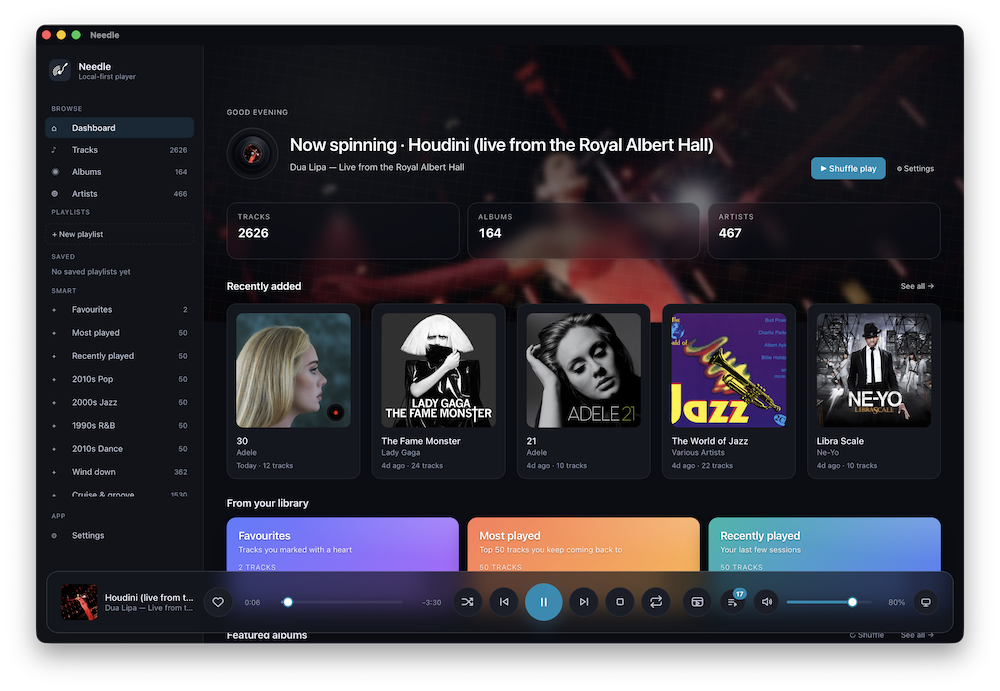
A dockerized backend. A web player. A desktop app. An Android app. Playback synchronization. Metadata management. Proper library curation. Device handoff. The whole thing slowly evolving into a personal Spotify-like experience, except this one is entirely mine.
No subscriptions. No algorithms deciding what I should listen to. No disappearing albums because licensing agreements changed overnight.
Just my music, curated the way I want it.
And naturally, once the foundation was there, the brain started doing what developer brains do best:
“Well… if we already have playback…”
“…then we should probably sync sessions…”
“…and if we sync sessions, the phone should resume playback…”
“…and if there’s a backend anyway, a web player makes sense…”
“…and if there’s a web player, remote access would be nice…”
And just like that, two weeks disappeared into a black hole of development.
The funny thing is that this wasn’t some isolated coding sprint either. Half the time I was bouncing between completely different layers of the stack. One moment debugging frontend playback behavior, the next configuring backups because after spending hours fixing metadata and organizing libraries, losing that data would feel like losing part of the project itself.
And somewhere in between all that, I also started ripping vinyl records into the system. Which somehow feels incredibly fitting.
There’s something deeply satisfying about taking physical records, carefully digitizing them, cleaning up metadata, embedding artwork, organizing everything properly, and then watching those albums instantly appear across players I built myself.
It feels personal in a way modern streaming services never quite do.
And then there’s the feature I’m probably most proud of: handoff.
Pause playback on the desktop app, grab the phone while heading out the door, and the Android app quietly offers to continue exactly where you left off. Same playlist. Same track. Same position.
It genuinely feels magical when software starts behaving like it understands context.
That’s the beauty of personal projects. They force you into learning things you’d otherwise never touch. A few weeks ago, I wasn’t thinking about playback session synchronization between devices. I wasn’t thinking about backend state management for multi-device handoff. I certainly wasn’t thinking about Docker deployment flows for self-hosted music ecosystems.
Yet here we are.
Personal projects quietly expand your horizons because they’re driven by curiosity rather than obligation. You keep pushing because you genuinely want to see what happens next.
Of course, modern AI tools played a massive role in accelerating all this. GPT helped enormously. Claude helped enormously. The speed at which ideas can now move from concept to implementation is honestly wild.
But I also think there’s a misconception about “AI-built software.”
I’m still deeply involved in every decision.
I read the code. I question suggestions. I reject approaches that feel wrong. I rethink architecture when it starts drifting into nonsense. Sometimes the best solutions appear after arguing with the AI for twenty minutes because something about its proposal simply doesn’t sit right.
I’m probably still an old-school developer at heart. I like understanding what’s happening underneath things. I like control over the code. AI isn’t replacing that process — it’s accelerating it. The real magic still happens in the back-and-forth between experience, intuition, curiosity, and refinement.
And perhaps that’s exactly why personal projects become so consuming.
They stop feeling like work and start feeling like exploration.
Client work has deadlines, invoices, specifications, and browser compatibility issues from the depths of hell. Personal projects, on the other hand, become playgrounds where ideas evolve faster than common sense can keep up.
Which is also precisely what makes them dangerous.
Because invoices do not magically pay themselves while you’re busy implementing seamless playback handoff between devices.
Client emails sit patiently in the corner like neglected houseplants while you convince yourself that adding “just one more feature” at 2:17 AM is perfectly reasonable adult behavior.
It is not.
But every once in a while, a personal project reminds you why you fell in love with technology in the first place.
Not because of contracts, deliverables, or optimization reports.
But because building things is genuinely exciting.